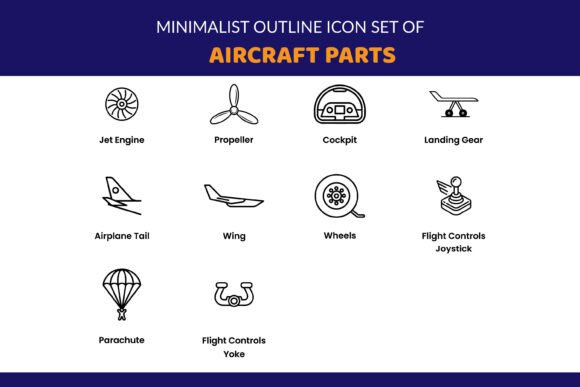
Aircraft Parts Minimalist Outline Icons Review
As a designer who spends more time than I care to admit staring at stitch density charts and debating thread colors, I approach every new embroidery file with a mix of curiosity and skepticism. We all know the drill: a design looks pristine on a high-resolution screen but falls apart under the needle. Today, I am putting Aircraft Parts Minimalist Outline Icons through its paces. This isn’t just about whether it stitches well; it is about whether it adds value to your handmade product, elevates your brand, and actually sells.
The premise is simple yet effective. The set features a clean, modern vector illustration of aircraft parts and flight control equipment rendered in a minimalist outline style. For those of us in the craft business, this specific aesthetic—clean lines, negative space, and technical precision—is currently trending. It bridges the gap between industrial ruggedness and modern graphic design. But does it translate from a digital asset to a tangible finished product? Let’s dive into the practical realities of using these graphics for real-world projects.
First Impressions and Visual Personality
When you first load Aircraft Parts Minimalist Outline Icons into your digitizing software or previewer, the immediate takeaway is clarity. Minimalist outline designs are tricky because they rely entirely on the strength of their lines. If the curves are too tight or the gaps too narrow, the machine will struggle, resulting in tangled threads or broken fabric. From a visual standpoint, however, this set exudes a sense of professional competence and aviation passion.
The mood created by these icons is one of precision and adventure. They feel right at home on apparel that targets mechanics, pilots, aviation enthusiasts, or parents who love travel-themed nursery decor. Unlike busy, detailed pictorial designs that can look cluttered when stitched, the outline style allows the fabric itself to become part of the design. This is crucial for custom apparel where you want the texture of the material to show through, particularly on heavier fabrics like denim or canvas.
Real-World Application: The Tote Bag Scenario
To truly evaluate any machine embroidery design, I need to imagine it on a customer’s body or in their home. Let’s take a realistic scenario: preparing a custom embroidered tote bag for an Etsy listing targeting frequent flyers or airport staff. Imagine a sturdy, natural-colored canvas tote. You place a single, large outline icon of a jet engine or a landing gear component near the center or slightly off-center.
Because the design is minimalist, it doesn’t overwhelm the bag. Instead, it acts as a sophisticated badge of identity. When a customer picks up this bag, they aren’t just buying storage; they are buying into a niche community. The stitch density required for an outline design is generally lower than a fill stitch, which means less stress on the fabric and faster production times for you. For an Etsy seller or small shop owner, this efficiency translates directly to better margins. The design feels premium, not cheap, because the negative space gives it room to breathe.
This same logic applies beautifully to other items. Picture a sweatshirt embroidery project for a pilot’s family member. A subtle outline of a control yoke or a compass rose on the chest pocket area creates a personalized gift that is understated yet meaningful. It avoids the "costume" look that sometimes plagues overly literal aviation graphics, replacing it with a modern, streetwear-inspired vibe.
Performance Across Different Fabrics and Projects
The versatility of Aircraft Parts Minimalist Outline Icons shines when we consider different embroidery project types. These design assets work exceptionally well on structured items where the fabric provides support. An embroidered patch for a backpack or a jacket collar is a prime candidate. The clean lines ensure that even if the edges are finished with a dense satin stitch border, the internal details remain crisp and legible.
However, not every surface is created equal. While these icons look great on flat surfaces like aprons, tea towels, or pillow covers, caution is advised when moving to curved surfaces. Attempting to embroider fine outline details on the curved crown of a cap can lead to distortion if the hoop size isn’t managed correctly. The tension might pull the lines slightly out of shape, turning a perfect circle into an oval. In such cases, testing on scrap fabric first is non-negotiable.
For baby clothes or delicate items, the minimalist nature of the design is a huge plus. Babies’ skin is sensitive, and heavy satin stitches can be scratchy. Outline designs often use running stitches or lighter satin touches, making them softer against the skin. A tiny outline of a propeller on a onesie is adorable without being bulky. It fits the trend of gender-neutral, modern nursery decor perfectly.
Where to Exercise Caution
Despite its strengths, there are specific situations where Aircraft Parts Minimalist Outline Icons might require adjustments. First, consider dark fabrics. If you plan to use light-colored thread on a black hoodie, the contrast will be striking, but you must ensure the line weight is thick enough. Very thin lines can get lost or break during stitching on textured fabrics like terry cloth or fleece. If you are working with a fabric texture that is highly pronounced, the outline might disappear into the weave.
Another critical factor is the hoop size. If the original design contains extremely small details—tiny screws, minute text, or intricate gear teeth—you need to ensure your hoop is large enough to accommodate the entire motif without cropping. Cropping a minimalist design can ruin the balance, leaving a floating line that makes no sense visually. Always inspect small details before committing to a run.
Technical Considerations for the Designer
Before you hit “start” on your machine, there are several technical checks every professional should perform. Thread color selection is paramount. With outline designs, the thread color defines the shape. Black thread on navy fabric might lack definition, whereas white thread on charcoal offers sharp contrast. Experiment with metallic or variegated threads sparingly; while they add flair, they can obscure the clean lines that make this design appealing.
Stabilizer choice also plays a significant role. Because these are outline icons, they may have large open spaces. Without proper backing, the fabric might pucker around the perimeter of the design. A cut-away stabilizer is often recommended for woven bags and hats, while tear-away might suffice for knits like t-shirts, provided the design isn’t too large. Check whether the design works for both personal and commercial projects by reviewing the license terms carefully. Many digital embroidery files come with restrictions on how many finished units you can sell.
Final Verdict: Does It Add Value?
In conclusion, Aircraft Parts Minimalist Outline Icons is a strong addition to any designer’s library. It offers a professional, contemporary look that resonates with a broad audience, from hobbyists to serious commercial embroidery businesses. Its strength lies in its simplicity and adaptability. It doesn’t try to do too much, which is exactly why it works so well in a market saturated with busy, loud designs.
For the creative entrepreneur, this design offers a low-risk, high-reward opportunity. It produces a handmade product that feels custom and thoughtful without requiring hours of complex digitizing or expensive materials. Whether you are creating holiday gifts, boutique branding, or printable mockups for digital products, these icons provide a reliable foundation. Just remember to test your setup, respect the limitations of your fabric, and let the clean lines speak for themselves. When executed well, the result is a piece of art that is as functional as it is beautiful.